Life · Ministry · Faith

Month: July 2015

Tending to your Bamboo

Bamboo Bike

A story keeps crossing my path lately. I am not sure of its original source, but I wanted to share it with you.

A farmer will plant bamboo and he will water and fertilize it the first year. And nothing will happen.

The second year he will faithfully attend the plant. Watering and fertilizing and nothing will happen.

The third year he will again spend it watering and fertilizing only to see nothing for his work.

The fourth year will be spent in the fields once more watering and fertilizing. And the year will close showing no purpose or progress for the hours spent tending.

The fifth year he will repeat the process again. But this time he will watch the plants grow sixty feet in six weeks time. So fast you could almost stand there and watch the plants grow.

The question to be asked: How long did it take the bamboo to grow sixty feet, six weeks or five years? The answer is obviously five years. For if there had not been the previous years of careful work and faithful service there would not have been the fifth year of stunning growth. Bill Gates said, “Most people overestimate what they can do in one year and underestimate what they can do in ten years.” Our failure of estimation often leads us to stop too soon on our dreams or sometimes to never start.

When nothing is happening and life is not growing and your dreams and plans don’t seem to be going anywhere do what you can do in your life: dig, plant, fertilize.

Invest in yourself. Invest in others. Never give up.

Pastor Stephen

A Good and Holy Life

Standing in the Woods

Timothy Keller, in his book Center Church, says that “Legalism says that we have to live a holy, good life in order to be saved. Antinomianism says that because we are saved, we don’t have to live a holy, good life.” And I would add that Gospel says that because we are saved we get to and are empowered to live a good and holy life.

What do you think?

Pastor Stephen

Let Love Roll

peace

On the night that Jesus was betrayed, as he washed his disciples feet and became a servant he said these words to his disciples: “A new command I give you: Love one another. As I have loved you, so you must love one another. By this everyone will know that you are my disciples, if you love one another.” (‭John‬ ‭13‬:‭34-35, ‬ NIV) It is funny that he would call it a new command. For the three prior years of active ministry he would live out this command to love one another and he would call his disciples to follow his example. On this night, however, love would become unmistakable.

What is love? Paul would tell us so eloquently in 1 Corinthians: “Love is patient, love is kind. It does not envy, it does not boast, it is not proud. It does not dishonor others, it is not self-seeking, it is not easily angered, it keeps no record of wrongs. Love does not delight in evil but rejoices with the truth. It always protects, always trusts, always hopes, always perseveres. Love never fails.” (‭1 Corinthians‬ ‭13‬:‭4-8a, NIV)

Racism is deeply embedded in our country and its effects are felt on many different levels. It can cloud our vision and cause us to see what is not there to be seen. My challenge to each of us is that we engage each other with love. When we are tempted to make comments in social media or share another’s words ask yourself if your words are words of love to the “other side.” When one’s actions do not make sense, ask yourself what the lens of their life might be which would cause them to respond in the way they did. One does not have to agree but we must understand for without understanding we have no hope for reconciliation.

The stakes could not be higher for Christians. By our love for one another the world will know that we are followers of Jesus and by our unity we will demonstrate to the world that Jesus is God (John 17:23). The reverse is also true for those of us who call ourselves Christians, our lack of love demonstrates are not truly Jesus’ disciples and our disunity give them a reason to question Jesus himself. Ultimately true reconciliation in the hearts and lives of people can only happen through the reconciling work of Jesus in each of our lives.

Finally, I want to share with you a resource I would highly recommend. It is the autobiography of the civil rights worker, John Perkins, Let Justice Roll Down. As I read in these pages how his brother was murdered by a sheriff’s deputy in 1946. Then as I read of members of his church being loaded into a police van that did not go directly to the police station but instead stopped along the way to beat the people in the back. I was again struck by the similarity to today’s events. Through poignant words and a deep conviction for reconciliation through the good news of Jesus Christ, John Perkins has much to teach us.

Blessings,
Pastor Stephen

Cower or Fight: Building Trust

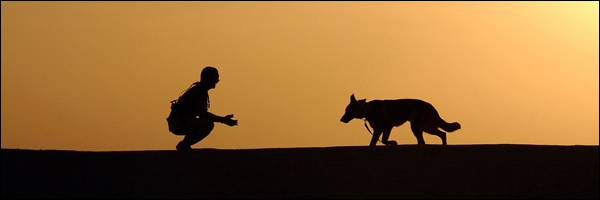
Man and Dog

I have been driving the same truck for nineteen years. I can’t change it. It has a little button. A wonderful, great and glorious marvel of modern engineering. The likes of which I have not found in vehicles before or since. The “scan” button. With the press of the button, my radio will automatically advance to the next station it finds with adequate signal strength. You may be saying to yourself, “my car has such a button.” But here is where you are mistaken. Many vehicles have a “seek” button, even my relic has such. This button advances you to the next station found and stops. Many vehicles also have “scan” buttons, but these advanced forward to the next programmed station. My button is unlike these. Mine is a triumph of automotive auditory engineering. With the press of this little beauty, my radio will advance to the next signal it finds but only pause there for a few seconds before automatically advancing again to the next signal of strength, repeating this process perpetually until commanded to stop. For those who have made TV channel surfing an Olympic sport, this wonder brings your years of training into the automobile. Many times I can be found driving and listening to forty-seven radio stations, all at the same time. It is a thing of beauty. Almost brings a tear to the eye just to think about it.

It was on one of these radio binges that I was caught by the words of a preacher. I do not know his name. I do not know the church he was preaching in. I do not even know what radio station he was on. But the words I heard were like a flash of light to my understanding.

We have all seen the pictures of dogs beaten and abused. From a distance, they look like normal friendly animals. But when you step up close and stick out your hand to scratch him on the head a switch in the dog’s psyche goes off and memories of past abuse flood the mind of the dog. Instinctively the dog will cower in terror or run. Other dogs will have the opposite reaction. Fear will overwhelm them and they will lash out in anger striking at the hand extended in love and friendship. This preacher made the connection that African Americans are like the beaten dog. For centuries, they have been abused and excluded in our society. Abuse that all too often continues today.

I remember recently seeing a friends post to Facebook in response to the swimming party debacle in Texas: “If you are not guilty don’t run.” Great advice, unless your life experience has been one of injustice and abuse. Then the prudent thing to do is to run . . . or fight. The history of beatings and abuses of power by those in authority against African American people in our country is long and well documented. The passing of the 13th Amendment in 1865 may have abolished slavery, but it did not change human hearts or behavior. The abolition of segregated schools in 1954 and the Civil Rights Act of 1964 did not change human hearts or behavior. We still have a very long way to go.

One final observation. If I wish to regain the trust of the beaten dog. The one whose natural reaction is to cower or bite. On whom does the greater burden of trust building rest, on me or the dog? The answer is obvious: On me. This is the great challenge we all face and the even greater challenge faced by our law enforcement. Centuries of abuse cannot be erased from the human psyche in a day or with the passage of law. Many well-meaning officers have reached their hand out to members of their community in love and friendship only to be bitten. But we must not give up the hard work of gaining trust.

In my next post, the last of this series, I will offer some insights on a way forward for each of us. In the meantime, I welcome your comments and thoughts. Please visit our website and post them below this post or make them on Facebook.

Blessings,
Pastor Stephen

What are you looking through?

camera lens

It was always there. That cannot be refuted. Its presence was not always seen or felt, but it came into focus one morning listening to a broadcast on NPR.

The broadcast brought together two women, close friends, a reporter and a police officer.

The reporter: An African American woman. Schooled in journalism. Trained to see what is not seen and to communicate knowledge to others.

The police officer: A caucasian woman. A veteran of the New York Police Department (NYPD).

Together these women would watch the video of Eric Garner being wrestled to the ground by officers of the NYPD and hear Eric’s pleading words, “I can’t breathe.”

Together they would watch the same video but it seemed as if they were watching something completely different from the other. Over and over again the officer would watch the scuffle and say “he is resisting, he is resisting.” The reporter couldn’t see it. All she could see was a man profiled for his race and the victim of excessive police force. By the end of the report, you could hear the strain in each woman’s voice. The tension came through the radio and I suspect their long friendship was hanging on by a thread.

What kept these two women, watching the same video, from seeing the same thing? Lenses.

A lens focuses our attention. In days past, to take a picture, one had to manually adjust the camera’s lens’ to bring into focus that which you were taking a picture of. Two people could stand on the edge of the Grand Canyon. One might choose to focus their lens on the small yellow flower struggling to bloom on the canyon’s edge. Another might take the same picture but instead focus on the vast expanse of the Arizona skyline. Both pictures are an accurate representation of what each photographer saw and chose to emphasize.

Each of us sees our world through a unique lens. A lens honed by the experiences of our life. Most of us never give any thought to the lens through which we are looking at the world and in so doing, fail to realize that our lens is distorting our perceptions, allowing us to see some things and to not see other things. As the two women watched the same video neither could see what they other saw, because of their lens.

I began to wonder what my lens might be. I wondered what I might be seeing and what I might not be seeing because of how my life had honed my lens of perception. The truth is we cannot escape our experience and the way it will change the way we see the world around us but we can recognize that it is there.

I still cannot fully comprehend the protests in Florida, Missouri, Maryland and other places. But I can believe they are seeing this world differently than I.

For each one of us, step back and ask: Could there be another perspective I am not seeing? When I do not understand how another cannot see what seems so obvious to me ask: What life experiences might this person have had that causes them to see what they see?

Knowing we have a lens leads us forward to a path of understanding.

Pastor Stephen

© 2026 jumpingjersey

Theme by Anders NorenUp ↑